
Thomas Isaac has been in and out of the national news in his role as Kerala's finance minister since 2018 for various path-breaking tax initiatives. But it is 2020 that he has become more prominent, principally in the GST council.

In the June quarter of FY24, 51 per cent of consumers who took small-ticket personal loans already had more than four credit products at the time of accessing yet another new loan, compared with just 17 per cent in the June quarter of FY20, points out Tamal Bandyopadhyay.
The overall breadth was extremely positive as 1,714 stocks advanced while 1,008 stocks declined

Market breadth depicted gains with 1,476 advances over 1,403 declines on the BSE. 140 stocks remained unchanged.

'There's a huge need for advancements in current security incident logging and monitoring practices.'

Shaktikanta Das said in Washington, DC, that there was nothing sacrosanct about the 25 bps rate cut and that monetary policy could be well served by calibrating the size of the policy rate to the dynamics of the situation, and the size of the change itself could convey the stance of policy.

While the RBI can nudge things along, ultimately bank owners must recapitalise and review internal processes to ensure that a culture of irresponsible lending doesn't continue, says Devangshu Datta.

India's consumer price index (CPI)-based inflation could ease in the coming months thanks to the arrival of kharif crops, lower international commodity prices, and a pass through of lower input costs to consumers, the finance ministry said in its Monthly Economic Review (MER) for October, which was released on Thursday. The MER, however, warned that the global macroeconomic situation remained precarious and a recession in many advanced economies would impact India's exports. "Easing international commodity prices and new Kharif arrival are set to dampen inflationary pressures in the coming months.

'The RBI has not allowed any commercial bank to fail in the past three decades.' 'It has always played the role of a matchmaker, but this is the best deal it has stitched,' notes Tamal Bandyopadhyay.

he reason behind the cut in policy rate seems to be a slowing economy

The new tax rates will come into effect from January 1, 2019.

The consolidated entity can target good growth FY18 onwards, analysts say.

Even if Mudra steps in to play its main role of refinancing at some stage, the responsibility for the bad loans remains with the banks.

'We should look at is full year's growth rather than quarter numbers.'
Headed by Urjit Patel, MPC for the fourth straight time kept the repo rate unchanged, at which it lends to the banks, at 6.25 per cent. The reverse repo, at which RBI borrows, will be 6 per cent.

Jaitley said that the banks have to play an important role in achieving the higher growth rate.

Investors who decide to enter medium to long-duration funds should be cognisant of the risk.

Breaking the streak of continuous fall in outstanding amounts, non-resident Indian (NRI) deposits rose for the first time in the financial year to $134.54 billion in October 2022. The figure was $133.67 billion in September. Reserve Bank of India (RBI) data showed that NRI deposits were in shrinking mode for the first six months of FY23. They fell to $133.67 billion in September from $139 billion in March.

Perhaps half-way through India's demographic transition, what is the outlook for the future?

Consumer goods firms and auto companies are witnessing an upturn in rural demand, which had been lagging for most of FY24. Expectations of a bumper rabi crop harvest have helped turn the tide. The Reserve Bank of India's (RBI's) Monetary Policy Committee kept the repo rate unchanged last week, noting that as rural demand catches up, consumption is expected to support economic growth in 2024-25.

'The CM kept his cool, but his adviser was liberal with filthy language.' Tamal Bandyopadhyay recreates the diary of a general manager in a public sector bank, providing a glimpse of how they balance their work and life.

The main objective is to determine whether among these companies there are NBFCs that ought to have registered with the RBI for carrying on their NBFI activities.

Majority of respondents feel that the government in the forthcoming Budget will increase the standard deduction and give more incentives for housing loans.

Only when the RBI inspection started on September 19 did they realise that their game was up and one of them had sent a letter to the central bank, leading to the RBI crackdown, report Anup Roy and Subrata Panda.

In the broader market, BSE midcap and BSE smallcap indices underperformed the larger counterparts and ended flat with a negative bias.

There will very little direct impact from the US Fed's rate hike this time, as we are well prepared both to handle liquidity, outflow of FII funds and managing our currency. But that doesn't mean India will be out of the woods anytime soon, says M V Subramanian.

SBI and other public sector banks have decided to lend Rs 4,000 crore to Patanjali Ayurved for the acquisition of Ruchi Soya, which was facing bankruptcy proceedings under the Insolvency and Bankruptcy Code. The money lent by banks will help the PSBs to settle their exposure to Ruchi Soya with a haircut of 65 per cent. Banks led by SBI and others had earlier made claims of over Rs 12,146 crore against Ruchi Soya after the company failed to repay its loans.
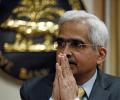
Reserve Bank Governor Shaktikanta Das on Friday said the rupee is holding up relatively well when compared to the currencies of emerging market peers and advanced economies. Days after the domestic currency breached the 80-level against the dollar, Das said Reserve Bank of India (RBI) has zero tolerance for volatile and bumpy movement in the rupee and added that the central bank actions have helped in smoother movement. He said RBI has been supplying US dollars to the market to ensure adequate supply of liquidity and also clarified that the central bank does not target a particular level for the currency.

Policymakers should aspire to restore the pre-Independence environment where the rupee was trusted and used all over South Asia, in Southeast Asia, in West Asia, and in East Africa, suggests Ajay Shah.

Their net NPA as a proportion of net advances were 2.2 per cent, compared with 1.7 per during the same period a year earlier.

Anup Roy and Krishna Kant on the challenges the public sector banks face in revitalising themselves

India retains the tag of the fastest growing country among the world's major emerging economies

The International Monetary Fund (IMF) on Tuesday slashed India's growth forecast for 2022-23 (FY23) by 80 basis points to 7.4 per cent, citing less favourable external conditions and rapid policy tightening by the central bank. In its update to the April World Economic Outlook, the IMF said that though a global recession in 2022 was ruled out with a growth estimate of 3.2 per cent, the balance of risks was squarely to the downside, driven by a wide range of factors that could adversely affect the global economic performance. "The risk of recession is particularly prominent in 2023, when in several economies growth is expected to bottom out, household savings accumulated during the pandemic will have declined, and even small shocks could cause economies to stall.

With this subdued forecast, India is likely to record its worst growth performance since the 1991 liberalisation. However, it is among the only two major economies, which will register a positive growth rate in 2020. The other being China, for which the IMF has projected a growth rate of 1.2 per cent.

The BSE Mid-Cap index was currently up 0.81%.
The Reserve Bank of India (RBI) is precariously balancing two opposing objectives - maintaining easy financial condition in the domestic market, while ensuring external stability - and economists have started taking note. They say India is going through the classic trilemma of the 'Impossible Trinity'. The RBI cannot have an independent monetary policy (setting domestic interest rates) in an environment of an open capital account and flexible exchange rates. What is even more complicated for the central bank now is that financial market stability overlays all the other three objectives.

Ahead of the 2023-24 Union Budget, the thinking at the top level of the central government is clear: Gross domestic product (GDP) growth of 6-6.5 per cent is a comfortable enough target for FY24 and the focus should be on fiscal consolidation to ensure that the sovereign cost of borrowing does not become prohibitively expensive in a high-interest rate environment, according to people in the know. Those aware of deliberations between the Prime Minister's Office (PMO) and the Ministry of Finance said while the Budget would look to strike a balance between infrastructure investment and welfare schemes, it is unlikely to be populist, though it will be the last full-year Budget before the 2024 Lok Sabha election. Incidentally, 6-6.5 per cent GDP growth is what the upcoming 2022-23 Economic Survey is expected to project for FY24.

Reserve Bank Governor Shaktikanta Das on Wednesday said underlying economic activity in India continues to be strong, but external factors will cause some "dent" to the economy. Speaking at the BFSI Insight Summit 2022 organised by Business Standard, Das said the RBI tracks 70 fast moving indicators and most of them are in the "green box". It is the external sector, mired by a fear of recession or clear visibility about slowing growth in a large part of the world, where the challenges lie, he said, adding that the impact of external demand will "dent" the economy.

RBI will make a presentation on January 24 before the panel on the state of NPAs and stressed loans.

Collectively, the pack of 12 has posted a 50 per cent rise in profits -- Rs 25,685 crore. On a quarter-on-quarter basis (that is, September over June), the rise is 68 per cent. Public sector banks have never had such a stellar performance, explains Tamal Bandyopadhyay.
